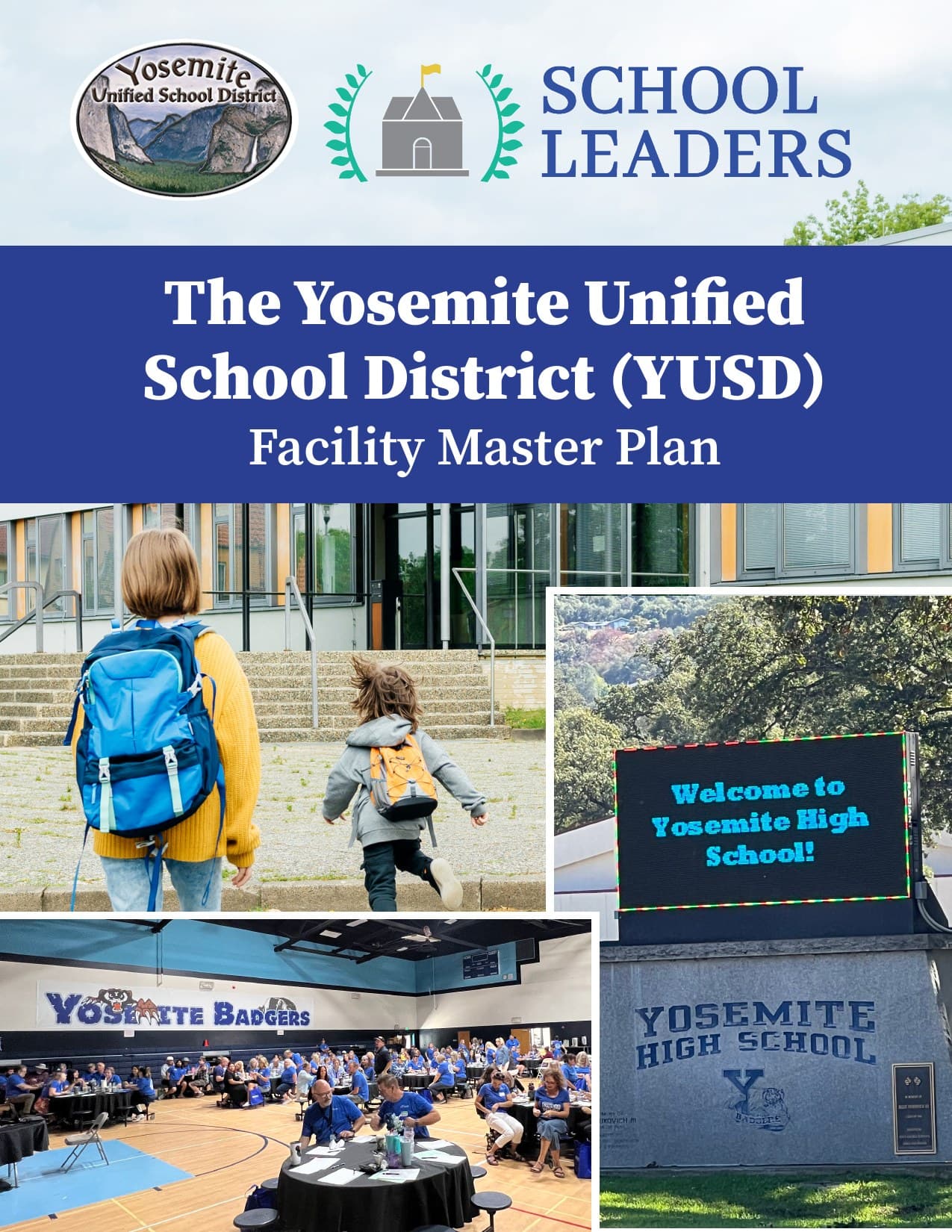
When the Yosemite Unified School District Board engaged School Leaders to lead its Facility Master Plan, the District faced a familiar California paradox. Enrollment had declined from 1,574 students in 2018–19 to 1,387 in 2024–25, but key sites were dramatically under-utilized — Yosemite High School at 47% of capacity, Rivergold Elementary at 66%. Aging portables from the 1970s and 1980s still housed core instruction. Roofs were failing. HVAC systems were past their service lives. And the District sat 24 miles from its smallest school in Raymond, in a rural Madera County region with low assessed valuation and limited local bond capacity.
The Board needed a master plan that could do three things at once: serve as a Prop 2- and OPSC-ready submission package to unlock state funding; survive board turnover and inform the next two to three bond measures; and earn the trust of a community that had watched previous planning efforts produce binders, not buildings.
Six months later, the District had all three. $74.8 million in preliminary capital costs documented and prioritized across every site. $9.2 million-plus in 2025 State Modernization Grant eligibility quantified per pupil. A maintenance plan tied to a five-year cycle. And — the part that changed how the community engaged with the plan — a live, public-facing webapp that lets any board member, parent, teacher, or community member filter the project portfolio by site, priority, and category and watch the budget roll up in real time.
This is how we built it, and why the webapp is now part of every master plan we deliver.
The District
Yosemite Unified serves the foothill communities outside Yosemite National Park — Oakhurst, Coarsegold, Bass Lake, Ahwahnee, North Fork — across one of California's largest geographic district footprints. The District operates Yosemite High School (557 students, 9–12), two K–8 elementary schools (Coarsegold and Rivergold), a small alternative high school in Raymond, and an adult school. Total enrollment has stabilized around 1,387 students after a decade of decline, with projections supporting a stable base and modest capacity for growth.
The condition picture, however, told a different story. An in-depth assessment across all sites identified four converging pressures:
- Safety and security gaps — none of the District's sites had a controlled single point of campus entry. Perimeter fencing was inconsistent. Surveillance was sparse. Emergency systems needed wholesale modernization.
- Aging core infrastructure — HVAC units past service life across most buildings, original roofing on multiple permanent structures, ADA non-compliance throughout, and Title 24 window-glazing failures.
- Programmatic deficiencies — no modern CTE facilities for agriculture, industrial technology, or culinary arts; aging portables housing instruction not aligned with 21st-century learning requirements; under-spec student support spaces.
- Under-utilized capacity — Yosemite High School at 47% and Rivergold at 66% utilization meant entire wings were carrying full overhead without delivering full instructional return. The plan needed to reconfigure, not simply renovate.
How the master plan was built
School Leaders structured the engagement across the six standard phases of a California facility master plan, with one important addition: a parallel software build delivering the live webapp alongside the published plan.
Phase 1 — Discovery and stakeholder engagement
Site walks at every campus. Interviews with the superintendent, cabinet, principals, maintenance and operations leads, and school staff. Review of every existing facilities document, maintenance log, and prior plan. Community focus groups, educator workshops, and online surveys. Outreach to families across the District's geographic spread — including Chukchansi Native American families served by the Coarsegold site — to ensure the engagement reflected the full community.
Phase 2 — Enrollment, demographics, and capacity
Historic enrollment analysis from CDE data back to 2014–15. Inter- and intra-district transfer trend analysis (209 outgoing IDTs in 2024–25, 47 incoming). Study Area Zone–based demographic projections through 2029. TK/Kindergarten student-generation rate modeling. Capacity-versus-enrollment analysis at every site to identify under-utilized space and the right footprint for the next decade.
Phase 3 — Educational specifications and guiding principles
A District vision statement and core beliefs translated into facility-design implications. Class-size and space guidelines. Educational program descriptors for each grade band. A Curriculum Hub model linking instructional goals — flexibility, collaboration, sustainability, safety, community engagement — to specific facility-design strategies. CTE and Ag-CTE adjacency requirements at Yosemite High School. Outdoor learning environments at every elementary site.
Phase 4 — Facility needs assessment
The heart of the plan. Every building, every system, every safety feature inspected and scored. 200+ discrete recommendations documented across 14 categories: Health/Safety/ADA, Sitework Safety, Roofing, HVAC, Building Site & Utilities Infrastructure, Building Envelope, Classroom Modernization, Restroom Upgrades, New Construction, Instructional Technology, Operational Support Services, Athletic/Community Use, Portable Facilities, and Landscaping/Outdoor Learning. Each recommendation carried a preliminary cost estimate, a priority assignment (1 = 0–2 years, 2 = 3–5 years, 3 = 6+ years), and a quantity/scope reference.
Cost rollups by site:
- Yosemite High School: $41.1M–$47.6M (depending on optional categories) across health/safety ($1.78M), roofing ($6.9M), HVAC ($3.59M), classroom modernization ($3.78M), new construction ($10.63M), and athletic/community use ($11.1M including pool reconstruction).
- Coarsegold Elementary: $13.1M including the in-progress water filtration project addressing magnesium, iron, and arsenic contamination, plus roofing, HVAC, classroom modernization, and a new library/music building.
- Rivergold Elementary: $20.4M covering safety upgrades, roofing, classroom modernization, multipurpose expansion, and outdoor learning environments.
- Other facilities (Raymond-Granite HS + YUSD Adult School): $216,000.
Total preliminary cost: $74,781,500.
Phase 5 — Financial strategy and OPSC readiness
The funding plan combined three sources. Local bonds calibrated to YUSD's assessed valuation and the 55% Prop 39 threshold. Developer fees at modest levels given the District's rural designation. And state grants, the largest single opportunity — Yosemite USD was confirmed eligible for $9,285,473 in 2025 State Modernization Grant funding under the SFP per-pupil rates (Elementary $6,034 · Middle $6,381 · High School $8,356), with an additional $2.5M+ available through related student counts and Mountain Home Charter. The District is also a strong candidate for Financial Hardship status under Proposition 2 given its rural designation and low assessed valuation base, which could ease the 40% local match requirement on state-funded projects.
Phase 6 — Maintenance plan
A five-year preventive maintenance schedule integrated with the capital plan. Annual cycles for HVAC, electrical, plumbing, and fire safety inspections; biannual cycles for roofing and exterior maintenance; a year-by-year capital sequence from baseline assessment (Year 1) through major systems overhaul (Year 4) to re-evaluation (Year 5). A recommendation to stand up a Computerized Maintenance Management System (CMMS) for tracking, accountability, and stakeholder reporting.
The webapp — making $74.8M understandable
A 170-page master plan is necessary but not sufficient. Boards adopt it. Cabinets reference it. But community members, teachers, and front-line staff rarely read it cover-to-cover — and the engagement gap between the published plan and the people who live in the schools every day is where most master plans quietly lose legitimacy.
For Yosemite USD, we built a live, public-facing webapp alongside the plan. The interactive demo below is a working replica of that deliverable — drawn from the actual project portfolio in Section VIII of the 2025 plan.
The webapp lets any visitor — a board member preparing for a Tuesday meeting, a parent at Rivergold wondering about playground shade, a teacher at Yosemite High School wondering when the roof on the 1500 building is up for replacement, a community member skeptical of how bond dollars would be spent — filter the project portfolio by site, priority, and category, and watch the budget, the state-match potential, and the phasing chart update in real time. It runs on any device, in any browser, with no login. Three things make it a substantive piece of district infrastructure rather than a marketing artifact:
- Every project shown is a real project from the plan — with the actual cost estimate, priority assignment, and category from Section VIII of the published document. The webapp and the PDF tell the same story.
- State-match math is exposed. As filters change, the app shows the estimated 60% Prop 2 / SFP state match against the eligible cost pool and the residual local match — so community members can see how YUSD is sequencing the local-bond conversation against state funding.
- It updates with the plan. When the plan refreshes — at the recommended three-year mid-cycle review or before the next bond measure — the webapp updates with it. No reprinting, no PDF version chaos, no out-of-date binder on a shelf.
(The interactive Master Plan Explorer renders below this narrative.)
Why this kind of webapp matters in California K-12
Most California districts spend between $80,000 and $250,000 on a facility master plan. They get a beautiful PDF, a board adoption resolution, and a press release. Six months later, the PDF is hard to find on the district website, and the project list is referenced from memory in budget discussions. The plan's authority quietly erodes.
A live webapp solves three structural problems that PDFs cannot:
- Community access. A community member who would never download a 170-page PDF will spend ten minutes filtering an interactive webapp. The legitimacy of the plan compounds with the number of people who actually engage with it.
- Board operational use. When the Board is making a budget decision in March, the webapp is the fastest way to see what Priority 1 projects haven't been funded yet, what their costs are, and where state match is available. The PDF can't do that in a meeting in real time.
- Bond campaign readiness. When the District goes to the community for the next local bond measure, the webapp becomes the spine of the community engagement — every dollar mapped to a real project at a real school, filterable by the community member's own school.
The webapp is now part of every master plan deliverable from School Leaders. Yosemite USD was the first; the model is portable to any California district running OPSC- and Prop 2-ready facility planning.
What the plan unlocks for Yosemite USD
Three immediate consequences.
State funding pursuit. The District can now move on $9.2M-plus of State Modernization Grant applications under the 2025 SFP. The plan documents the eligibility evidence — building age, modernization scope, per-pupil counts by grade band — that OPSC requires. Financial Hardship pursuit becomes credible with rural-designation and low-assessed-valuation documentation in hand.
Local bond readiness. Whenever YUSD's Board decides to return to the voters for a local measure, the foundation is in place — a documented $74.8M need, a defensible prioritization, an integrated maintenance plan, a webapp the community can engage with, and a five-year sequence the campaign can stand behind. The plan survives leadership transitions because it is anchored in process, data, and stakeholder voice, not in the personalities of the people who built it.
Operational discipline. The maintenance plan, the CMMS recommendation, the quarterly inspection cadence, the year-over-year capital sequence — these are the operating practices that prevent the next round of deferred maintenance from compounding. The Board, the cabinet, and the M&O team now have a shared calendar for facility stewardship.
Why this engagement is portable
Yosemite USD is rural, small, geographically dispersed, and fiscally constrained. The methodology that produced its master plan — six-month phased process, every-site needs assessment, OPSC-ready financial planning, integrated maintenance schedule, and a public-facing interactive webapp — works for districts at three to thirty times that scale. The cost discipline scales. The community engagement model scales. The technology backbone scales. What changes is the size of the project portfolio and the complexity of the funding stack.
If your Board is approaching a master plan refresh, a Prop 2 funding pursuit, or a local bond conversation, the YUSD playbook is a working reference — published document, live webapp, board-adopted plan, and a funding strategy that combines local, developer-fee, and state sources into one coherent capital trajectory.